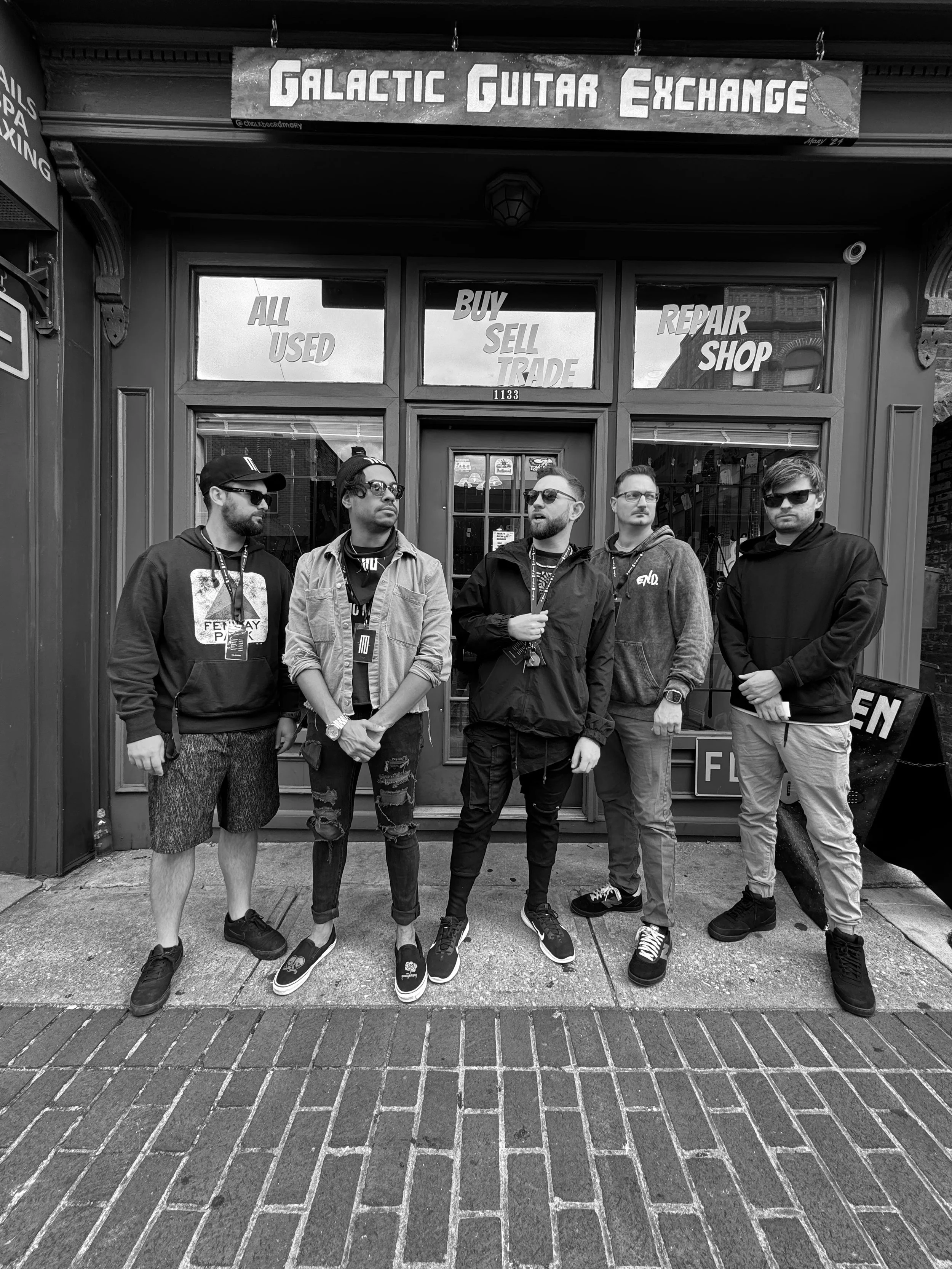
On Tour With Moments Of — Seven Shows, Seven Cities, One Van
I remember the van pulling up outside my apartment in Westbrook. A white Ford passenger van — one row of seats pulled out to make room for seven people and whatever comfort you could carve out between cities. My wife came outside to meet the band — pregnant, though we hadn’t told anyone yet. She shook hands, said hello, and waved me off with a smile while I loaded my gear and climbed in. We texted and called the whole trip. Every city. Every show. Every long drive through the night. Some context you carry quietly.
Tours look glamorous from the outside. They are not. They are early mornings, late nights, long drives, fast food, and the constant work of moving people and equipment from city to city and making it look effortless by showtime. Seven shows, seven cities — six days on the road plus a homecoming a month later. Seven of us in that van — five band members with road experience, a friend handling merch, and me with a camera. Band members who’d done this before took turns behind the wheel. Big trailers full of gear don’t drive themselves and neither does a white Ford passenger van at two in the morning somewhere between Raleigh and the Georgia state line.
No crew. No tour manager. Just a group of people who believed in what they were building enough to drive through the night to prove it.
That’s the version of music worth documenting.
What Nobody Tells You About Tour Photography
Forget what you think you know about shooting live music. Small venues are a completely different discipline than anything else behind a camera. The light is whatever the venue decides it is — and it’s almost never what you need. The moments are one-take. The energy is kinetic and unpredictable. You can’t ask for a second chance at the shot that just happened.
I learned two things fast. Fast aperture lenses aren’t optional — they’re the difference between an image and a blur. And fast autofocus isn’t a luxury — it’s the only reason any frame is sharp when a performer moves through a pool of light in a fraction of a second.
You figure that out fast or you come home with nothing.
What you can’t figure out fast — what only comes from shooting the same band night after night — is instinct. By the third or fourth show I could feel a solo coming before it happened. That feeling meant one thing: move now, get positioned, be ready before the moment exists. You can’t learn that from a single shoot. It only comes from repetition and presence.
Philadelphia — Foto Club
Philadelphia was the first city and nothing about it looked like what it would become. Foto Club from the outside looked like an empty building in the middle of the day — quiet, unassuming, the kind of place you’d walk past without a second look. Then the sun dipped and the room came alive. Light-up disco panels on the floor. Mirror balls overhead throwing colored light in every direction. Suddenly you’re shooting in one of the most visually distinct rooms you’ve ever been in.
The ambient light was low enough that the disco floor became one of the primary light sources in the room. I spent the first set learning how to use it rather than fight it. By the second set I was chasing reflections.
That’s the job. Every room teaches you something. Philadelphia taught me to look down.
Baltimore — 8x10
The drive to Baltimore took us past the wreckage of the Francis Scott Key Bridge — still down after the Dali container ship struck it earlier in the year. You don’t forget a sight like that. A major bridge just gone. The van got quiet for a moment. Then we kept moving.
The 8x10 was the most photographer-friendly room on the tour. Good light. Good sightlines. A venue that clearly understood what live music documentation should look like. Before the show the band found a food court across the street — nothing fancy, just a group of people eating before work. That meal stuck with me. The normalcy of it. The way a touring band eats dinner at a food court and then walks across the street and plays a show. The gap between the ordinary and the extraordinary is where documentary photography lives.
Raleigh — Neptune’s
Raleigh was quiet. Calm streets. A different energy than Philadelphia and Baltimore — slower, more measured. Neptune’s had wall art that would have stopped me in my tracks even without a camera. Bold, graphic, unmistakable. The problem was the light — deep red, low, unforgiving. Red light does things to skin tones that take real work to correct in post. I was pushing my autofocus to its limits trying to lock focus in a room that was fighting me the entire set.
What came out of Raleigh taught me more about post-production than any single shoot before it.
Then came the haul. Raleigh to somewhere in South Carolina or Georgia — we were never entirely sure exactly where we landed. A late night drive, the kind where you stop tracking miles and just watch the highway disappear under the headlights. The van smelled like seven people and a forgotten cooler. Nobody cared. Hotel in the middle of the night. Just enough time to crash before hauling again in the morning. Load in. Load out. Pack up and move before you’ve had time to get a sense of direction. That’s the rhythm of a tour. You stop being a tourist somewhere around day three and start being a machine.
Orlando — Will’s Pub — Florida Base of Operations
Will’s Pub was the best show of the tour. Full stop.
The crowd was there — not politely there, genuinely there. The energy in the room was the kind that a band spends years chasing and only occasionally finds. I stopped thinking about settings and started reacting. That’s the state every documentary photographer is trying to reach — when the technical decisions become automatic and the only thing left is seeing. Orlando gave me that.
Orlando was also the Florida base of operations. Tampa and Jacksonville were both run out of there — drive to the city, load in, play the show, load out, drive back. A different rhythm than the overnight haul between Raleigh and Florida. More contained. Orlando as a hub meant we could actually breathe between shows instead of collapsing into a hotel at 2AM not knowing what state we were in.
Tampa — Hooch and Hive
Hooch and Hive was dark, intimate, small crowd — the kind of venue where you can hear the conversations at the bar between songs. There’s something honest about a small crowd in the middle of a long tour. The band played the same show they played everywhere else for a fraction of the audience. That’s what separates the people who are serious from the people who aren’t. Tampa was a quiet night in the middle of a loud week — and it was worth documenting just as much as any other.
Jacksonville — Jack Rabbits
Jack Rabbits was open, well-branded, a stage that gave the band room to move. After the tight intimacy of some of the earlier venues Jacksonville felt spacious. More room to work. More angles. Better stage presence from the band because the room invited it. Some nights the venue gives the performance something extra. Jacksonville was one of those nights — a strong finish to the Florida run.
Then load out. Back to Orlando.
When the Florida run was done Orlando is where we split. Some of us flew home. The rest loaded the van for the long drive back to Maine. There’s something strange about stepping off a plane and being home while the people you spent six days with are still somewhere on I-95. The tour wasn’t over. It just split in two directions at the Orlando airport.
Portland — Aura — The Homecoming
A month passed between Jacksonville and the final show. Life resumed. Maine in the fall. The tour felt like something that had happened to a slightly different version of me.
Then Aura.
The biggest venue of the entire run. The biggest crowd. Press credentials issued by the venue — a first for this project. Friends in the audience. People who knew the band, knew the music, knew what it had taken to get here. The energy was enormous and somehow it still felt far away — the way hometown shows sometimes do when you’ve been somewhere else and come back changed.
I was a different photographer at Aura than I was at Foto Club. Six road shows had given me something that no single booking ever could — a complete understanding of this band in performance. I knew where to be before the moment happened. I knew when a solo was coming and I was already moving before the first note of it landed. That instinct was built show by show across six cities and it showed up fully at Aura when it mattered most.
The homecoming show was the right ending. Not because it was the biggest room or the loudest crowd — though it was both. But because it closed a loop that started with a white van pulling up outside an apartment in Westbrook and a pregnant wife waving from the sidewalk.
Seven shows. Seven cities. One tour. All of it worth documenting.
What The Van Taught Me
The shows are the product. The van is the education.
Six days on the road with seven people who all had a job to do taught me more about the music industry than any amount of time shooting from the photo pit ever could. How venues work. How ticket splits work. How merch tables work — who sets them up, who runs them, what sells and what doesn’t. What a tour manager actually does and why you need one. What it costs — in money, in energy, in days of your life — to move a band and their equipment from city to city and make it look effortless from the stage.
Documentary photography isn’t just about the frame. It’s about understanding what you’re documenting well enough to find the real story inside it. The van gave me that. The drives between cities, the late-night conversations, the details of how a touring band actually operates — that context is inside every image I made on that tour whether you can see it explicitly or not.
What It Did To My Photography
Seven shows across seven cities sharpens you in ways that a single shoot never can. By Aura I was a different photographer than I was at Foto Club. Faster decisions. Cleaner instincts. A complete understanding of when to move and where to be before the moment exists.
Live music in small dark rooms is the hardest environment I’ve shot in. It is also the one that has pushed my craft further than anything else. If you can work in a venue like Foto Club with a disco floor as your primary light source and come home with images worth keeping — you can work anywhere.
And somewhere in the middle of all of it — between the drives and the load-ins and the late nights and the shows — I was texting home. Checking in. Carrying something quietly that made every moment feel a little more worth documenting.
If You’re A Band, A Venue, Or An Event Organizer
This is exactly what I’m built for. Not the polished version of your show — the real one. The greenroom before the first song. The crowd during the one that lands. The merch table after the last note. The stuff that disappears if nobody is paying attention.
If you want someone who can keep up — reach out. The consult is free and I respond within 24 hours.